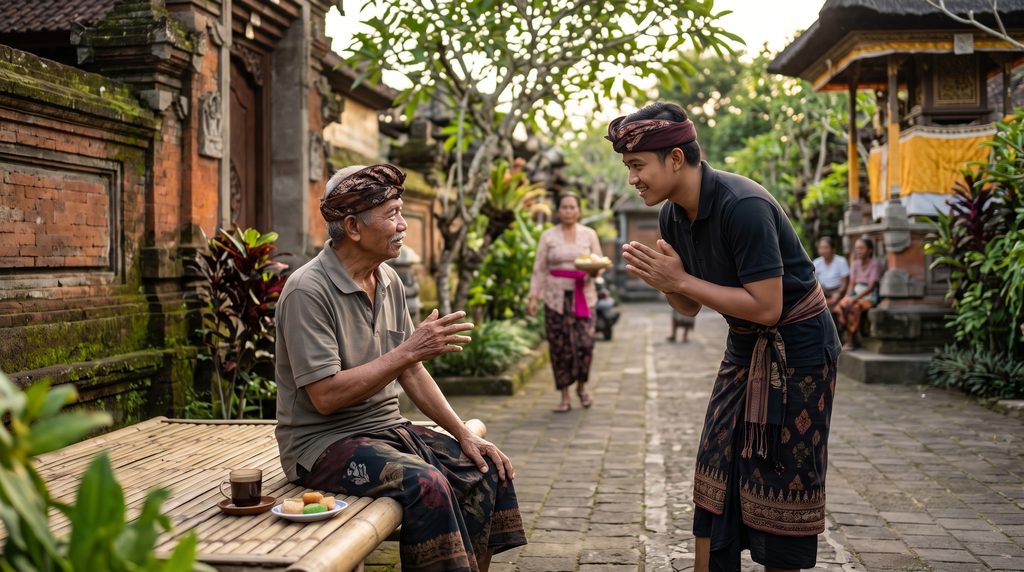
If you’ve spent time in Bali, you’ve probably met several people named Wayan, Made, Nyoman or Ketut. This isn’t a coincidence. The traditional Balinese naming system connects a person’s name with birth order, gender, cultural heritage and, in some cases, caste.
Understanding Balinese names is a fascinating way to learn more about family, religion and everyday life on the Island of the Gods.
Why Don’t Balinese People Traditionally Have Family Surnames?
Unlike Western naming systems, traditional Balinese names generally don’t use inherited family surnames.
A common structure is:
[Gender/Caste Title] + [Birth Order Name] + [Personal Name]
For example, I Wayan Sudharma can be understood as:
- I — male prefix
- Wayan — firstborn
- Sudharma — personal name
In modern situations, some Balinese people use their personal name as a surname on passports or international documents because these systems often require a family-name field.
The Four Main Parts of Balinese Names
1. Gender Prefixes: I and Ni
For many commoner families:
- I — traditionally used for males
- Ni — traditionally used for females
For example:
- I Wayan Sudharma
- Ni Kadek Ayu
Members of higher-status families may instead use traditional titles that indicate their social or family background.
2. Birth Order Names: Wayan, Made, Nyoman & Ketut
One of the most recognizable features of Balinese names is the birth-order system.
| Birth Order | Common Names | Notes |
| 1st | Wayan, Putu, Gede | Gede is particularly common for boys |
| 2nd | Made, Kadek | Both are widely used |
| 3rd | Nyoman, Komang | Both are common alternatives |
| 4th | Ketut | Traditionally associated with the youngest of four |
First Child: Wayan, Putu or Gede
Wayan is associated with the firstborn child. Putu is another common first-child name, while Gede is frequently used for boys.
Second Child: Made or Kadek
Second-born children are commonly called Made or Kadek.
Third Child: Nyoman or Komang
Third-born children traditionally receive Nyoman or Komang.
Fourth Child: Ketut
The fourth child is traditionally named Ketut.
The exact meanings and linguistic origins of these names can vary by interpretation and region, but their connection with birth order is one of the defining features of Balinese naming traditions.
What About a Fifth Child?
The cycle starts again. A fifth child may be given Wayan or Putu, followed by Made for the sixth child, and so on.
Some families may use Wayan Balik, with Balik meaning “return,” to distinguish a firstborn name that appears again in the same family.
3. Caste and Balinese Names
Balinese society has historically been influenced by the Catur Warna or Wangsa system. Traditional titles can indicate a person’s family or social heritage.
Brahmana
The priestly and scholarly class traditionally uses:
- Ida Bagus — male
- Ida Ayu — female
Ksatriya
The royal, noble and warrior class includes titles such as:
- Cokorda
- Anak Agung
- I Gusti
- Dewa
Female forms can include titles such as I Gusti Ayu, Dewa Ayu and Anak Agung Istri.
Wesya
Historically associated with merchants and administrators, Wesya families may use titles such as Ngakan, Kompyang, Sang and Si. Usage can vary between families and regions.
Sudra
The majority of Balinese traditionally belong to the Sudra or Jaba group. Their names generally rely on gender prefixes, birth-order names and personal names rather than aristocratic titles.
In modern Bali, caste generally has less influence over everyday occupations and social relationships, although titles and traditions remain important in ceremonies, language and some marriage customs.
The Title Jero
Jero can be used in certain circumstances for someone who enters a higher-status family through marriage. Its usage and meaning can vary depending on family and local tradition.
4. Personal Names
Because birth-order names are shared by many people, the personal name helps distinguish one person from another.
Many personal names have Sanskrit or Old Javanese influences and may express positive qualities or hopes.
Examples include:
- Dharma — duty or righteousness
- Suci — pure
- Ayu — beautiful
- Putra — son
- Putri — daughter
Names may be selected according to family traditions, religious considerations or guidance from a priest.
Why Are So Many Balinese People Called Wayan?
Because Wayan is traditionally associated with the firstborn child. Since most families have a first child, Wayan became one of the most recognizable names in Bali.
The same principle explains the popularity of Made, Nyoman and Ketut.
How Do Balinese People Tell Each Other Apart?
When many people share the same birth-order name, additional names and nicknames become important.
Someone might be identified by:
- Their personal name
- A nickname
- Their village or hometown
- Their occupation
- Their family compound
- Their parents’ names
Nicknames are especially common in everyday village and community life.
Balinese Names and Language
Names are also connected with traditional forms of respectful communication.
Balinese has different speech levels, and language choice can reflect age, social position and respect. Traditionally, more refined forms such as Basa Alus are used in certain interactions with people of higher social status.
Today, many Balinese people move comfortably between Balinese, Indonesian and English, depending on the situation.
Balinese Naming Traditions Today
Modern Bali has changed considerably through tourism, migration and globalization, but the traditional naming system remains strong.
Many families continue to use Wayan, Made, Nyoman and Ketut, while personal names may be more contemporary or international.
This combination of old and new allows Balinese naming traditions to remain relevant while adapting to modern life.
Tips for Visitors
If you’re curious about someone’s Balinese name, asking politely can be a great way to start a conversation.
Use the Name They Introduce
If someone introduces themselves as Made or Wayan, it’s perfectly appropriate to use that name.
Use Pak or Bu
For respectful everyday conversation, you can use:
- Pak + male name
- Bu/Ibu + female name
For example:
- Pak Made
- Bu Ketut
Ask About Meaning
Many Balinese people are happy to explain their names and birth order. Questions about caste can be more personal, so approach the subject respectfully.
Balinese Names FAQs
Do Balinese people have last names?
Traditionally, Balinese naming systems do not use inherited family surnames in the Western sense. Modern official documents may require people to adapt their names to include a surname field.
What do Wayan, Made, Nyoman and Ketut mean?
They are primarily associated with birth order. Wayan is traditionally firstborn, Made second, Nyoman third and Ketut fourth.
What happens if a family has more than four children?
The naming cycle can restart. A fifth child may again be called Wayan or Putu, followed by Made for the sixth child.
What does I and Ni mean?
I is traditionally used as a male prefix and Ni as a female prefix in many commoner families.
What does Ida Bagus mean?
Ida Bagus is traditionally a male title associated with Brahmana families. The corresponding female title is Ida Ayu.
Is the Balinese caste system still important?
Its influence is less pronounced in everyday life than historically, but caste or wangsa titles remain relevant in some religious ceremonies, language practices and family traditions.
Can I ask a Balinese person about their name?
Yes. Asking about the meaning of someone’s name is generally a friendly way to learn about Balinese culture. Just be respectful when discussing sensitive subjects such as caste.
Final Thoughts
Balinese names are more than simple identifiers. They connect people with family, birth order, cultural heritage and centuries of tradition.
The next time you meet a Wayan, Made, Nyoman or Ketut, you’ll know that the name may tell you something about where they fit within their family’s traditional naming cycle.
Learning the story behind Balinese names is a small but meaningful way to better understand the culture and people of Bali.