What Are Balinese Kites (Layang-Layang)? The Heart of Traditional Balinese Culture
Balinese kites (layang-layang) are grand, handcrafted structures built from bamboo frames and vibrant cloth or waxed paper, tethered to long strings that stretch high into the sky during Bali’s windy season. These magnificent creations are the soul of the Bali Kite Festival, an annual celebration that transforms the island’s skies into a living canvas of color, spirituality, and community pride.
In Bali, flying kites is far more than a simple pastime or a traditional game—it is a sacred religious practice and one of the island’s most cherished cultural traditions. Rooted in pre-Hindu animistic beliefs and later woven into Balinese Hinduism, this centuries-old tradition represents a spiritual connection between earth and the heavens—a way to express gratitude to the gods and pray for a bountiful harvest. This deep cultural foundation has made the Bali Kite Festival the centerpiece of kite-flying heritage and a defining element of Balinese identity.
The tradition honors Sang Hyang Rare Angon, the deity of wind and animals, embodied as a shepherd boy who protects livestock and summons the wind through a magical flute. The process begins with blessings from village spiritual leaders (Balians), who consult the traditional Balinese Saka calendar to select the most auspicious days to begin construction.
Even the colors carry deep spiritual meaning: black, white, red, and yellow represent the manifestations of key Hindu deities. Together, these sacred hues transform what might look like a simple kite into a meaningful offering to the sky.
A Tradition Beloved Across Generations and Villages: The Annual Bali Kite Festival
Every year during the windy season between June and September, Bali’s clear blue skies come alive with vibrant kites flown by children, families, and elders across every village on the island. The peak Bali Kite Festival months—July and August—bring ideal offshore winds that carry handcrafted creations to soaring heights. Even outside these months, you can spot kites dancing in the sky almost any time of year.
Known locally as layang-layang, traditional Balinese kites feature intricate designs, bold shapes, and striking colors. Far more than a favorite pastime, this cherished custom has remained a cornerstone of island culture for centuries.
Whether flown casually over emerald rice fields or gathered along coastal shores, kite flying brings communities together in a beautiful display of connection. The highlight of the season is the annual Bali Kite Festival in Sanur—the ultimate gathering point where thousands of local teams and international spectators line the beach to celebrate this timeless tradition.
The Three Traditional Types of Balinese Kites
There are at least three types of traditional Balinese kites you can find today:
Bebean Kite — Shaped like a fish, this kite symbolizes prosperity and fertility. The name “bebean” comes from the Balinese word “be,” meaning fish. These can reach up to 10 meters in length and are beloved for their graceful movements in the wind.
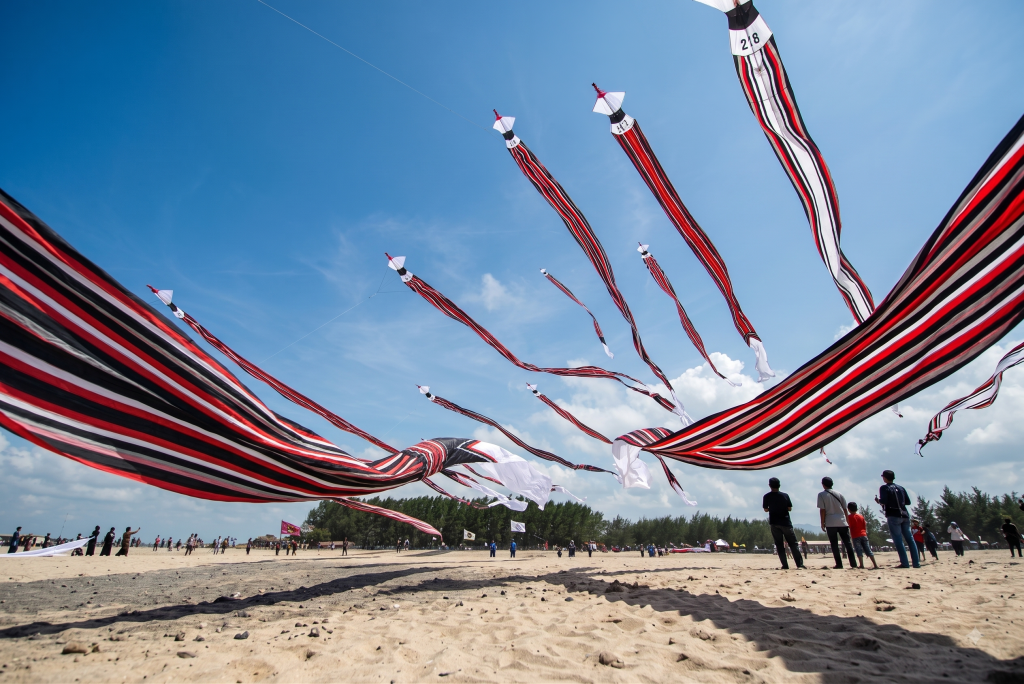
Janggan Kite — Depicts a long-tail bird or dragon, the Janggan is built to honor “Naga Basuki,” the mythological dragon king. Its broad flowing cloth tail can stretch beyond 100 meters in length, making it one of the most spectacular sights in Bali’s sky during kite season.
Pecukan Kite — Shaped like an enormous leaf, this is known to be the most difficult to fly. Requiring immense skill, coordination, and often a large team to manage, the Pecukan is favored by experienced flyers who understand the nuances of wind and balance.
The Art of Kite Making: From Bamboo Strips to Silk
Learning from Elders: A Cross-Generational Tradition
From a very young age, boys in Bali are taught to craft their first kites using bamboo and thin, colorful paper known locally as kertas minyak. This cherished father-son bonding activity allows generations to pass down not just craftsmanship, but cultural knowledge and spiritual understanding. The meticulous shaving of pliable bamboo strips and the careful sewing of colorful panels are skills learned through patient repetition alongside trusted elders.
As these boys grow into adults, the materials and the scale evolve. Adult kite makers replace fragile paper with durable silk or lightweight cloth sewn tightly onto massive bamboo frames, and swap standard string for heavy-duty rope to navigate the sky. This cross-generational knowledge transfer ensures that the sacred art of kite-making survives for future generations.
Building Giants: A Community Endeavor
To fly these giant kites—some measuring 5 meters or more across, not even counting the tail!—a massive community effort is required. It often takes a coordinated team of 70 to 80 people to launch and pilot a single kite, transforming the flight into a grand social event. This collective effort reinforces community bonds and ensures the tradition survives another generation.
Giants of the Sky: Record-Breaking Balinese Kites
The largest kites in Bali are engineering marvels wrapped in spiritual devotion. The legendary fish-shaped kite belonging to the Meranggi family is perhaps the most famous: it boasts a tail of 150 meters in length, weighs 80 kilograms, and comes with a wingspan of 10 meters and a length of 15 meters. Managing such a kite requires an army of skilled hands, unwavering focus, and deep respect for the forces of nature.
These colossal creations are not made for casual play—they are built for ceremonial significance and community pride, representing the peak of kite craftsmanship and the spiritual aspirations of entire villages.
History of the Bali Kite Festival: From Ancient Tradition to Global Celebration
Origins: The Sacred Roots of Kite Flying
Kite flying in Bali has ancient roots, deeply embedded in the island’s pre-Hindu animistic traditions and later integrated into Balinese Hindu practice. Historically, farmers would fly kites after planting rice seeds to request rain and a bountiful harvest from Rare Angon, the wind deity. Beyond the agricultural roots, kite flying represents the spiritual bond between earth and sky, grounding people to their ancestors and their land.
The Festival Formalization: 1978 Onwards
As tourism began to flourish in Bali during the 1970s, the provincial government saw an opportunity to preserve and celebrate this cherished tradition. In 1978, the first official annual Bali Kite Festival was launched at Padang Galak and Mertasari beaches in Sanur, transforming what had been a seasonal village tradition into a competitive spectacle. This formalization was designed to conserve kite-making skills among young Balinese and attract international interest while maintaining cultural integrity.
The festival quickly gained traction, and by the 1980s and 1990s, it evolved into an international competition that drew kite flyers and enthusiasts from around the world. Today, it stands as one of Indonesia’s most celebrated cultural events, with teams competing for prestigious trophies including the Governor’s Cup.
The Ultimate Guide to the Bali Kite Festival & Cultural Traditions
What are these green, blue and red lights in Bali’s night sky?
During kite season, some flyers attach small lights or reflective materials to their kite strings. As the sun sets, these catch the last rays of light or reflect from nearby sources, creating an ethereal display. However, most of what you see are the kites themselves, silhouetted or glowing faintly against the twilight sky.
What is the cultural significance of Balinese kites?
Balinese kites are far more than recreational objects. They serve as spiritual messengers, carrying prayers and offerings to the gods. Kite flying is an expression of Hindu-Balinese cosmology, reinforcing the belief that harmony must be maintained between humans, animals, nature, and the divine. The practice embodies Tri Hita Karana—the three pillars of Balinese philosophy emphasizing harmony with God, other humans, and nature.
What is the main meaning behind flying Balinese kites?
Flying kites is an act of gratitude and supplication. Traditionally, farmers would fly kites after planting rice seeds to request rain and a bountiful harvest from Rare Angon. Beyond the agricultural roots, it represents the spiritual bond between earth and sky, grounding people to their ancestors and their land.
When are Balinese kites flown?
The prime kite season runs from June through September, with peak activity in July and August when the southeast winds blow strongest and most consistently. However, enthusiasts fly kites year-round whenever conditions permit. Many villages time their major kite festivals and competitions to align with the strongest wind months.
How are Balinese kites made?
Kite construction is a multi-stage process involving bamboo harvesting, careful shaving of frames, selection and sewing of colored silk or paper, and attachment of tails and lines. The process is sacred—ceremonies bless the materials and construction milestones. Village Balians consult the lunar calendar to determine auspicious days to begin work. Large kites may take weeks or months to complete and involve entire communities.
Why are Balinese kites special?
Their combination of artistry, engineering, and spiritual purpose makes them unique. Balinese kites are not mass-produced toys—each one is handcrafted with intention, blessed for its purpose, and imbued with cultural meaning. They represent centuries of tradition, family lineage, and deep religious devotion.
How do Balinese kites bring communities together?
Kite flying transforms into a social and religious event that unites villages. Families gather in rice fields and beaches to fly together. Large competitions require teams of builders, flyers, musicians (gamelan bands), and flag bearers. Festival preparations take months, giving entire banjars (local communities) a shared goal and identity. This communal aspect is showcased beautifully during the Bali Kite Festival, where entire villages march together in colorful processions.
Why is the Bali Kite Festival important for preserving this Balinese tradition?
The Bali Kite Festival, especially the renowned Sanur event, serves as a cultural anchor that keeps the tradition alive for new generations. By bringing this sacred activity into the spotlight annually, the festival ensures that young Balinese continue learning kite-making skills and understanding the spiritual significance behind this beloved custom. The festival also provides economic opportunities for local artisans and attracts global interest, helping secure the tradition’s future.
How high can these kites climb?
With strong winds during the dry season, Balinese kites can reach remarkable heights—often hundreds of meters above the ground. The exact ceiling depends on the kite’s design, the string’s strength, and wind conditions. Large kites can climb so high they appear as mere specks to the naked eye.
When is the best time to experience the Bali Kite Festival?
The Bali Kite Festival runs as an annual event from June through September, with peak season typically in July and August when winds are strongest and most consistent. If you’re planning a visit specifically to witness the Bali Kite Festival, these months offer the best conditions for seeing hundreds of kites in action. Beyond the official festival in Sanur, you can find kite-flying activities throughout Bali during the dry season, with various regional competitions and celebrations.
What is the best place to see the Bali Kite Festival?
The best place to see the Bali Kite Festival is undoubtedly Sanur Beach, which hosts the most organized and visually spectacular version of the festival from June through August. Sanur offers the advantage of organized competitions, large crowds of skilled flyers, cultural processions, and gamelan performances—all set against a scenic beach backdrop.
However, the best place to experience the Bali Kite Festival depends on your preferences. If you prefer a more authentic, local experience away from organized tourism, the rice fields around Ubud or village celebrations in Gianyar offer equally memorable encounters with this sacred tradition. For a casual, laid-back atmosphere, Canggu Beach provides year-round kite-flying opportunities with a relaxed vibe. Whatever location you choose, visiting during peak season (July–August) ensures you’ll witness the Bali Kite Festival in full action.
Where to Experience the Bali Kite Festival: Best Locations & Travel Guide
The Bali Kite Festival: Sanur’s Most Anticipated Annual Event
Since its inaugural launch in 1978, Sanur has been home to the renowned Bali Kite Festival—an annual gathering that draws massive crowds, including kite enthusiasts from around the globe. Widely considered the island’s premier destination for this traditional activity, Sanur offers an unmatched spectacle featuring hundreds of participating teams.
At the heart of the competition are groups from various Balinese banjars (local village communities), each entering their skilled flying team, known as a Sekaa Layangan. These teams spend months meticulously crafting their giant creations to compete for the ultimate prize.
During the Bali Kite Festival, the sky transforms into a vibrant canvas filled with imaginative designs—ranging from traditional sacred figures to modern superheroes, animals, and cartoon characters. Beyond the standard competition, the cultural theme category showcases deep spiritual heritage: village priests bless the kites before launch, while teams of 70 to 80 members—complete with kite flyers, traditional gamelan musicians, and flag bearers—march together in matching attire.
Today, the Bali Kite Festival stands as a major global attraction, offering international visitors a front-row seat to a rare blend of sport, art, and spirituality. For the Balinese, it remains a meaningful time to honor their ancestors, celebrate their heritage, and reinforce the communal bonds that unite their villages.
Beyond Sanur: Other Top Locations to Experience the Balinese Kite Tradition
While Sanur remains the premier venue for the main festival due to its scale and official setup, Bali offers several other incredible spots to witness this cherished traditional activity:
Gianyar: This cultural region hosts its own regional kite festivals and competitions throughout the dry season. Offering a more intimate, local atmosphere, it is a fantastic alternative for those looking to experience the Bali Kite Festival traditions without the massive festival crowds.
The Rice Fields Around Ubud: During kite season, the lush paddies surrounding Ubud fill with traditional kites soaring overhead. Flying here offers a peaceful, authentic, and uncommercialized experience set against Bali’s serene countryside.
Canggu Beach: A favorite gathering spot for casual flyers and hobbyists throughout the season. While not an official Bali Kite Festival competition site, it provides a relaxed coastal setting to watch local flyers in action and even join in the fun.
Local Village Banjars: Many local communities (banjars) across the island celebrate the season with their own village-level mini-competitions and family gatherings. Asking locals about upcoming village events often leads to authentic, off-the-beaten-path celebrations of kite-flying traditions.
Ultimately, the best place to experience Balinese kite flying depends on what you are looking for—whether it is the grand, high-energy spectacle of Sanur during the Bali Kite Festival, the regional pride of Gianyar, or the quiet warmth of a village tradition. Regardless of where you go, watching hundreds of vibrant kites dancing across Bali’s clear blue sky is an unforgettable sight.
Final Thoughts
To watch Balinese kites dance across the sky is to witness centuries of tradition, spiritual devotion, and community connection brought vividly to life. Whether standing amidst the rice fields of Ubud, along the shore in Canggu, or on Sanur Beach during the Bali Kite Festival, the sight of hundreds of colorful kites against the clear blue sky reveals something profound: in Bali, even play is sacred, and the simplest pleasures carry the weight of history.
This timeless traditional activity reflects the island’s deep cultural roots and spiritual philosophy. Kite flying is far more than recreation—it is a living bridge connecting the Balinese people to their ancestors, their gods, and the land. Whether you encounter local families on a breezy afternoon or experience the grandeur of the Bali Kite Festival, you are witnessing one of the world’s most meaningful cultural practices.
If you visit Bali during kite season, take time to seek out the experience that resonates most with your travel style—from the organized spectacle of Sanur to the quiet charm of village celebrations. Simply look up, and you might just catch a prayer riding the wind, carried skyward by a tradition that continues to captivate generations.