Most countries celebrate independence with one day of fireworks. Indonesia stretches it into a full month. And if you’re watching it unfold from a village in Bali rather than the streets of Jakarta, you’ll notice the celebration comes with an extra layer: right alongside every Merah Putih (the red-and-white flag) snapping over a warung, hotel gate, or rice paddy, you’ll still find a fresh canang sari offering sitting at the temple gate that same morning — exactly like any other day. On this island, national pride and daily devotion have always shared the same street corner, which is a big part of what makes Kemerdekaan feel different here.
As August 1st hits, homes, offices, shopfronts, and school gates across the country raise the Indonesian flag for the entire month leading up to the big day. This year happens to be a milestone one — Indonesia turns 81 on August 17, 2026, under the official National Theme “Indonesia Berdaulat, Adil, dan Makmur” (Sovereign, Just, and Prosperous Indonesia). But ask anyone in a Balinese banjar what the whole month is really about, and you’ll probably get a simpler answer than any government slogan: gotong royong — everyone pitching in, together.
What Is Hari Kemerdekaan (Agustusan), Exactly?
Hari Kemerdekaan — literally “Independence Day” — is Indonesia’s national holiday marking August 17, 1945: the date Sukarno and Mohammad Hatta proclaimed independence after more than three centuries of Dutch colonial rule, with a brutal Japanese occupation squeezed into the final years of World War II. Most Indonesians just call it 17 Agustus, and the season of build-up around it — flag-raising, games, parades — gets its own nickname: Agustusan.
Every province marks it, but the shape it takes shifts depending on where you are. In Bali, Hari Kemerdekaan effectively runs on two tracks at once: the standard national program you’d find anywhere in Indonesia — ceremonies, school parades, red-and-white bunting everywhere — layered over the island’s own customary structure, the banjar. A banjar is the traditional Balinese hamlet association that organizes most of communal life on the island (temple duties, ceremonies, local disputes, and yes, Independence Day too), running alongside, but separate from, the formal RT/RW administrative system used elsewhere in Indonesia.
The History Behind the Day — And Bali’s Own Chapter In It
The short version: on the morning of August 17, 1945, just two days after Japan’s surrender ended World War II, Sukarno and Hatta read a brief proclamation of independence outside a house on Jalan Pegangsaan Timur in Jakarta. That didn’t settle things. The Dutch spent the next four years trying to reclaim their former colony, and Bali paid a steep price for it.
On November 20, 1946, Dutch forces surrounded a Balinese resistance unit — the Ciung Wanara battalion, commanded by Lieutenant Colonel I Gusti Ngurah Rai — near the village of Marga in Tabanan. Rather than surrender, Ngurah Rai called for a puputan: a fight to the death, rooted in an older Balinese tradition that treats death in battle as more honorable than surrender. Nearly the entire battalion — around 96 fighters, Ngurah Rai included — died that day. The site is now a memorial park, Taman Pujaan Bangsa, and Ngurah Rai’s name greets every visitor who’s ever flown into the island — Bali’s international airport is named after him. It’s a heavier story than most Independence Day roundups get into, but it’s a big reason August 17th carries its own weight here.
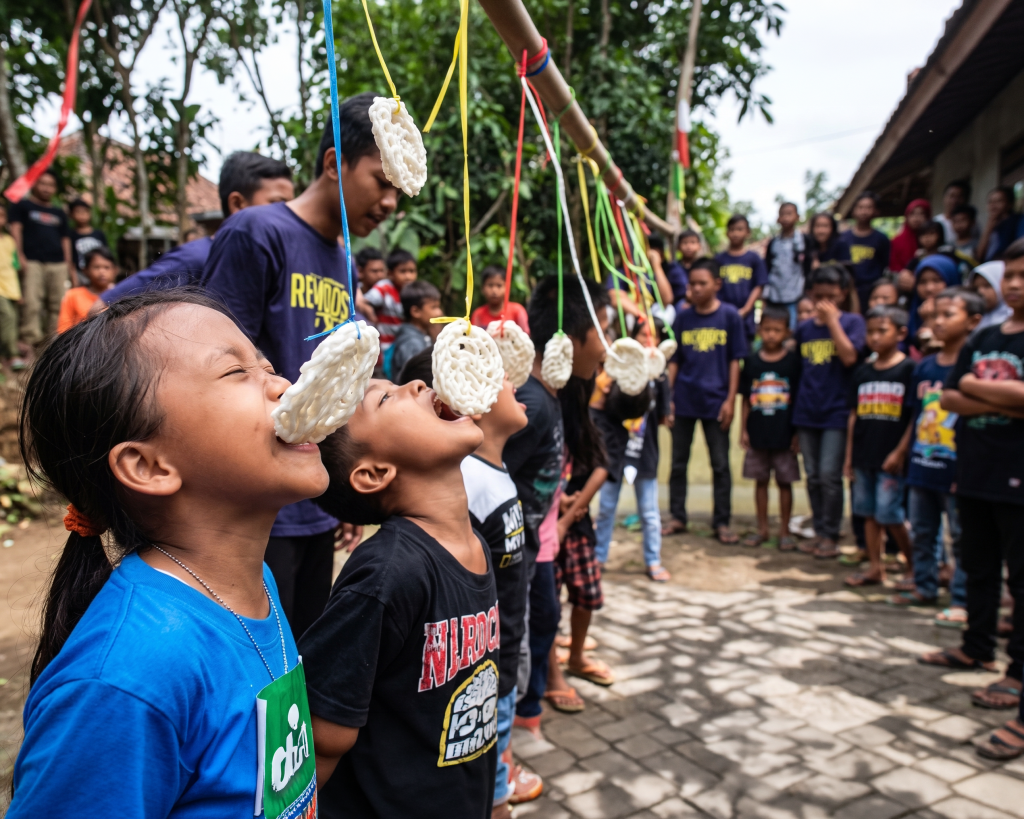
Even the lighter traditions have real history behind them. Panjat Pinang, the greased-pole climb, wasn’t originally a patriotic tradition at all — Dutch colonists staged it (they called it klimmast) at colonial celebrations like Queen Wilhelmina’s birthday every August 31st, watching for entertainment as local villagers scrambled up an oiled trunk for prizes as modest as a sack of rice or sugar. After independence, Indonesians kept the game and flipped its meaning entirely, turning it into a symbol of teamwork, since nobody has ever climbed a greased pole alone. Balap karung, the sack race, echoes the scarcity of the Japanese occupation years, when burlap sacks sometimes doubled as clothing. Makan kerupuk dates to the 1950s, a nod to a time when a simple cracker was, for some families, all there was. None of it makes the games any less fun to watch today — if anything, it’s why they’ve stuck around for eight decades.
A Month-Long Sea of Red and White
Throughout August, the whole island transforms. Homes, villas, warungs, offices, and schools fly the Merah Putih, and every banjar gets a little competitive about it — streets fill with red-and-white bunting, hand-painted murals, and gates decorated by whichever group of neighbors got the most ambitious that year. In tourist hubs like Kuta, Seminyak, and Ubud, hotels and restaurants join in too, so visitors get a front-row seat to the buildup even if nobody warned them it was coming.
The Sacred August 17th Ceremonies
August 17th itself opens and closes with two formal, genuinely moving ceremonies, repeated at every level of Indonesian life — from the Presidential Palace in Jakarta down to the smallest village hall:
- Morning: Upacara Pengibaran Bendera (the Flag-Raising Ceremony)
- Late afternoon: Upacara Penurunan Bendera (the Flag-Lowering Ceremony)
In Bali, the morning ceremony often happens at the Balai Banjar — the community hall anchoring every hamlet — rather than a government building. Residents gather for the flag raising, a reading of Pancasila (Indonesia’s five founding principles), and a moment of silence for everyone who died fighting for independence, Ngurah Rai included. It’s simple, unhurried, and about as far from a stadium spectacle as a national ceremony gets, which is exactly why it’s worth witnessing if you’re staying somewhere near a banjar.
Cultural Parades & Grand Spectacles
Alongside the formal ceremonies, Bali fills the month with parades and performances that lean hard into local identity. Many villages hold what’s known as PORSENI (Pekan Olahraga dan Seni, or “Sports and Arts Week”) throughout August — a mash-up of standard sports tournaments (football, volleyball, table tennis) and distinctly Balinese arts competitions, including barong dance showcases and baleganjur, where teams of young gamelan musicians march and play at the same time, judged on sound and choreography together. School and neighborhood karnaval parades add another layer, with kids and adults dressing in traditional dress from across the archipelago — Balinese payas included — alongside costumes honoring national heroes and, inevitably, a few kids dressed as Garuda, wings and all.
It’s increasingly common for beach resorts around Kuta and the south coast to fold visitors into the fun, too — think a marble-and-spoon race on the sand, sometimes paired with a baby sea turtle release beforehand, as a properly Bali-flavored way of sharing the tradition with guests who happen to be on the island for 17 Agustus.
High-Energy Traditional Street Games (Lomba Agustusan)
Right after the morning ceremony wraps up, the banjar comes alive with lomba agustusan — the street games that are, for most Indonesians, Balinese included, the actual highlight of the day. Expect laughter, mild chaos, and fierce pride over the smallest prizes:
Classic Individual Games:
- Balap Karung (Sack Race): Participants hop toward the finish line inside burlap sacks, falling over about as often as they cross it upright.
- Makan Kerupuk (Cracker-Eating Contest): Contestants race to finish a cracker dangling from a string, hands tied behind their backs — no hands allowed, dignity optional.
- Balap Kelereng (Marble-and-Spoon Race): Runners balance a marble on a spoon held between their teeth, moving just fast enough to keep it from rolling off.
Team & Community Challenges:
- Panjat Pinang (Greased Pole Climbing): Teams work together to scale a tall, heavily greased areca-nut trunk to reach prizes tied at the top, usually by forming a human pyramid, since no one’s ever managed it solo.
- Tarik Tambang (Tug-of-War): A straightforward test of strength and teamwork using a thick rope, often fought out banjar versus banjar.
- Bakiak Panjang (Giant Wooden Clog Race): Teams of three to five strap their feet onto one long wooden plank and have to move in perfect sync, or faceplant trying.
A Taste of Merdeka: What’s on the Table
No Balinese gathering is complete without food, and Agustusan is no exception. Once the games wind down, banjars often move straight into a communal meal, and it’s worth knowing what might be on the table: babi guling (spit-roasted suckling pig, rubbed with a dense Balinese spice paste called base genep), lawar (minced meat or jackfruit tossed with vegetables, grated coconut, and spices), and sate lilit (minced fish or chicken satay pressed onto lemongrass stalks instead of skewers). For something sweet, look for jaje Bali — the catch-all term for traditional Balinese cakes — a warm bowl of kolak, or es campur, a mixed ice dessert loaded with fruit and syrup that tends to disappear fast in the August heat.
Joining In as a Visitor
Tourists are genuinely welcome to watch, and often to join in — Independence Day in Bali isn’t a closed, private affair. A few things worth keeping in mind:
- Dress modestly if you’re near a temple or a formal ceremony, even if you’re only passing by.
- Expect some road closures or slower traffic near ceremony sites and parade routes on the morning of the 17th.
- If a banjar invites you into a game, say yes. It’s considered a genuine compliment, not just a photo opportunity.
- Ask before photographing ceremonies up close. A quiet nod from a local organizer goes a long way.
Final Thought
Indonesia’s national motto, Bhinneka Tunggal Ika — Unity in Diversity, pulled from a 14th-century Old Javanese poem — sums up the spirit of the country’s Independence Day. Bali just happens to have its own, older framework for the same idea: Tri Hita Karana, the Balinese philosophy of maintaining harmony across three relationships — with the divine, with each other, and with nature. Watch a village celebrate 17 August here and you’ll see all three in motion: a flag ceremony that opens with prayer, a tug-of-war that only works because everyone pulls together, and a communal feast shared under the same red-and-white bunting hanging over the temple gate. Whether you’re cheering on a Panjat Pinang team from the sidelines or just watching the flag go up at a village hall, Agustusan in Bali offers something most national holidays don’t: a genuinely local reason to believe in the “unity” part of Unity in Diversity.